



 87 / 92

87
Additionally, basic rudders are
provided, but the customer can design
and print rudders tailored to the mission
and operating environment. “This
freedom allows the user to optimise the
hydrodynamics of the vehicle, to meet the
physical challenges it will endure during
its deployment,” said Jordan Thomas
from Planet Ocean, Gabri’s UK partner.
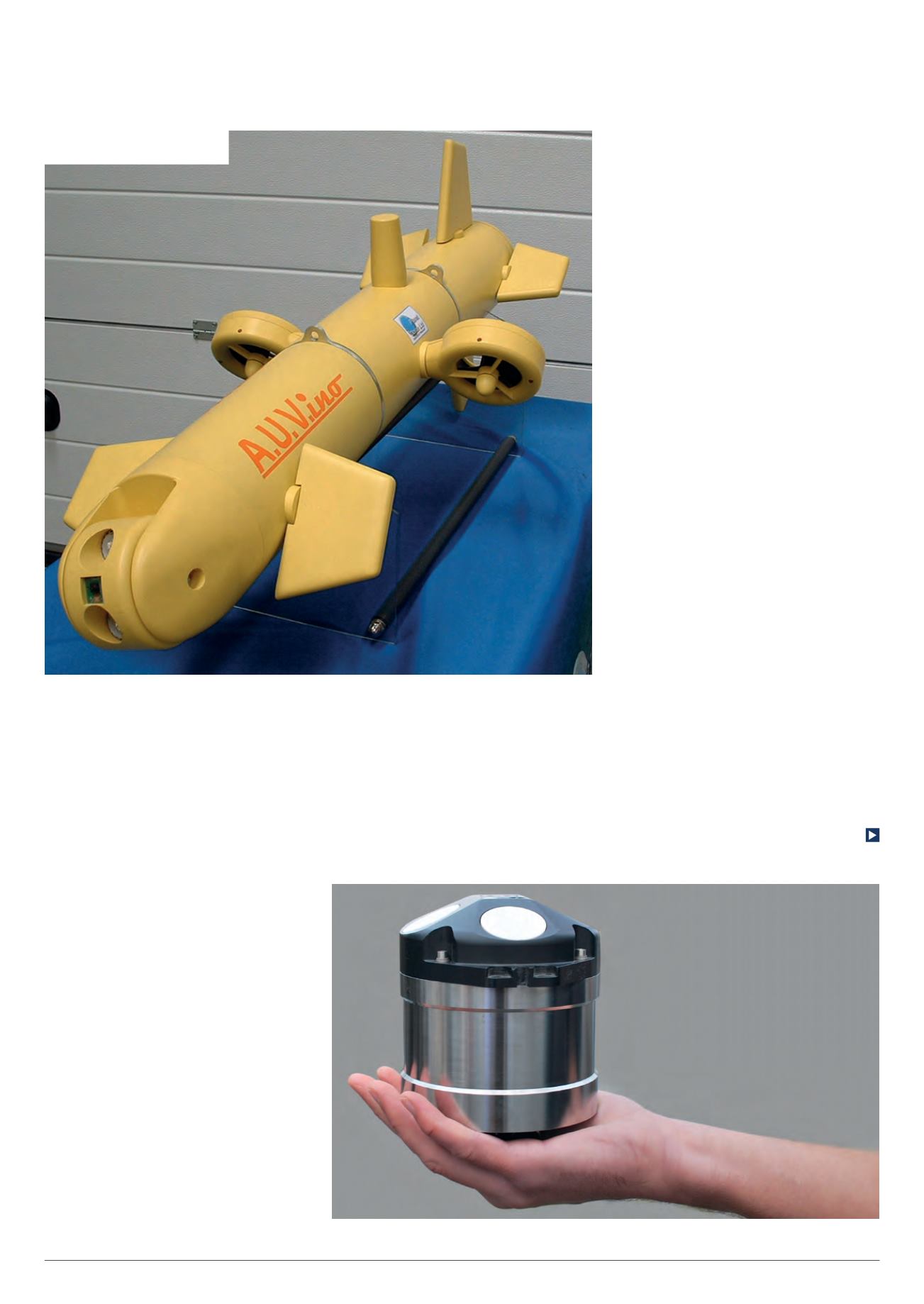
The resulting craft is 1200 mm long
and 160 mm wide (500 mm including
motors), weighs 24 kg and has been
tested to a depth of 100 m. Endurance
is from two to eight hours, depending
on sensor payload, and the top speed
is 3 knots, although that speed can
be increased by reconfiguring various
elements of the AUV.
Nortek has developed a new DVL
module. In line with the trend towards
smaller UUVs, the 1 MHz unit is 12.2 cm
tall, 11 cm in diameter, and weighs
2.8 kg – 800 g for the head and
electronics, and 2 kg for the titanium
housing.
As well as being smaller than standard
DVLs, the module offers more precise
navigation than current systems by
including information such as data
quality parameters and time stamps with
a 1 ms resolution in the data stream.
Minimum accuracy of water tracking
and current profiling run to 1% (±0.5
cm/s), and long-term accuracy of bottom
track velocity up to ±0.2%/±0.1 cm/s,
with either 16 or 64 Gbytes of internal
memory available.
The module can use an RS232 or
RS422 serial interface, or an Ethernet
interface with auto-MDIX and speeds
from 10 to 100 Mbit/s, running on TCP/
IP, UDP and HTTP protocols. It also
offers bottom lock for greater ranges, soft
bottoms, and operation very close to the
bottom with a 1000 m depth rating.
Teledyne unveiled its latest riverine
USV, the Z-Boat 1800 RP, with a number
of improvements over previous designs,
including a modular deck structure for
cameras, antennae and additional sensor
mounting for shallow coastal mapping
missions. The newly ruggedised IP67-
rated hull comes with an interchangeable
sensor well beneath the vehicle, for
expedient integration of Teledyne
payloads such as the Odom MB2 and
CV100, and various RDI ADCPs and
Tritech side scan sonars.
Although boats of this size often use
fibreglass, the Z-Boat’s hull is built from
ABS with an acrylic layer, for improved UV
resistance, workability, and for quick
Oceanology International 2016
|
Show report
Unmanned Systems Technology
| June/July 2016
Nortek’s new DVL is smaller
than standard units
Once built, the SeaStick AUVino
can reach a depth of 100 m